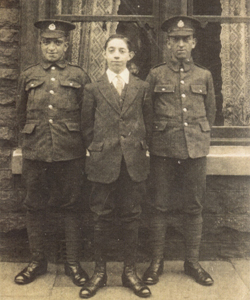
Although this page was originally written as a brief guide to researching the service records of men from the Accrington, Sheffield and Barnsley Pals battalions, it is mostly relevant to WW1 army service records in general.
The Absent Voters List for 1918 is a valuable yet under-used resource and is often available at public libraries. Anyone who was eligible to vote in 1918 but was absent because of wartime service can be found listed alongside his permanent address, service number, rank and battalion or regiment. The Accrington 1918 Absent Voters List is available here. The names and addresses of local men recently returned from prisoner-of-war camps in Germany were published in the Accrington Gazette on 11th January and 1st March 1919, and are available here. The Prisoners of the First World War website makes available 5 million index cards on prisoners-of-war and 500,000 pages of associated records held by the International Committee of the Red Cross, but be aware that the quality of indexing on the site is extremely variable. Persistence is often rewarded by finding details including date & place of birth, name & address of next-of-kin, and date (& location) when captured. The Medal Rolls Index gives the service numbers and regiments of every soldier with a medal entitlement, and can be searched through the websites of both The National Archives (TNA) and Ancestry. Scans of Medal Rolls Index cards can be downloaded from either website; The National Archives charge £3.50 per download (July 2017) whereas Ancestry is a subscription-based service but provides scans of better quality (and a free trial subscription is often available). Be aware that the index card may give no additional information other than reference numbers to the corresponding entries in the Medal Rolls. (Tip: I generally prefer to use the better and free search facility on the TNA website to tie together a soldier's name, number and regiment.) The British War and Victory Medal Rolls themselves can now be accessed through Ancestry as well as at The National Archives in Kew. For an infantryman, his entry in these rolls details each battalion with which he served after first going overseas. The Silver War Badge Rolls also available through Ancestry and at Kew detail the service number, rank, name, regiment and dates of enlistment and discharge for more than 880,000 WW1 servicemen who were discharged through sickness or wounds. Best of all would be to find the soldier's service record. Unfortunately, the majority of WW1 service records for ranks other than officers have been destroyed, at least in part thanks to a 1940 air raid. Those that survived – fewer than 40% – are available either at Kew (WO 363, the so-called Burnt Documents), or online through both Ancestry and find my past; of the two online services, I prefer the search facility of find my past which also allows both Burnt and Unburnt Documents (see below) to be searched in one operation. The chance of finding a service record varies greatly from regiment-to-regiment; sadly, surviving records for men who served with the East Lancashires are few and far between. In an attempt to replace some of the records which were lost in 1940, the so-called Unburnt Documents (WO 364) were created from Ministry of Pensions records. Although these account for only around 8% of the original records, all are accessible either at Kew, or online through both Ancestry and find my past. The situation is different for officers, whose records have generally survived to a greater or lesser extent and can be inspected in their original form at Kew. (An exception seems to be the records of R.A.M.C. officers, which have been unaccountably lost.) Officers' records are in WO 374 (Territorial Army commissions) or WO 339 and can be searched (but not viewed) online here. The National Archives also provide a list of independent researchers. The online database maintained by the Commonwealth War Graves Commission is searchable by name and gives date of death, service number, battalion, place of burial or commemoration, and possibly some family details as well. Geoff's WW1 Search Engine is an alternative and more versatile interface to the database. The World War 1 Centenary Project provides maps showing the locations of all known Commonwealth cemeteries and memorials from the war. Soldiers Died in the Great War was originally published in 1921 in 80 volumes, but is now available on a single CD-ROM which also contains the accompanying Officers Died in the Great War. It is usually possible to tell from these volumes where a serviceman was born, lived and enlisted. The CD-ROM product is now available in many local libraries. The CD content can also be accessed (£) through the Ancestry, find my past or Forces War Records websites. The Register of Soldiers' Effects available (£) through the Ancestry website contains details of the money owed to soldiers of the British Army who died in service from 1901 to 1929. Records typically include the name of the soldier's beneficiaries and their relationships, and the date (and sometimes the place) of death. Local newspapers of the time generally published biographical sketches of the local killed, missing and wounded, often together with a photograph. Microfilm copies of the Accrington Observer & Times and Accrington Gazette can be consulted at Accrington Library, the Sheffield & Rotherham Independent, Sheffield Daily Telegraph and The Star at Sheffield Library and the Barnsley Chronicle and Barnsley Times at Barnsley Library. Wartime editions of the Burnley Express and Burnley News can be searched and read (£) online through find my past. Accrington Library also has on file personal details of the more than 850 Accrington Pals who died during the war. There is only a small chance that the service records of a soldier who died during the war can be located at The National Archives. It is also worth checking the sample (around 2%) of widows' and dependants' pension forms (PIN 82) which are held at The National Archives and can be searched here. Regimental or divisional histories often give detailed accounts of a battalion's activities, but can be difficult to locate. A copy of The History of the East Lancashire Regiment in the Great War 1914-1919 edited by Major General Sir N. Nicholson is held at Accrington Library and at the Lancashire Infantry Museum; click here for details of a recent reprint. Many of the Pals battalions have been the subject of recent books, published by Pen & Sword. Battalion, Brigade and Division war diaries vary in content, but often contain maps and detailed operational plans as well as a daily record of activities. A user-friendly online facility for searching the collection of war diaries held at The National Archives (WO 95) is provided by Arcre. The diaries of many British Army battalions which served on the Western Front are also available (£) on the Ancestry website. Accrington Public Library The library is home to the William Turner Pals Collection. Also available are the local 1918 Absent Voters List, details of the more than 850 Accrington Pals who died in the war, microfilm copies of the Accrington Observer & Times and Accrington Gazette, CD-ROM and printed versions of Soldiers Died in the Great War, the 75 volumes of The Official History of the Great War, and The History of the East Lancashire Regiment in the Great War 1914-1919. Sheffield Local Studies Library The library holds microfilm copies of the Sheffield and Rotherham Independent, Sheffield Daily Telegraph and The Star. Sheffield Archives and Local Studies Barnsley Central Library The library holds copies of both the Barnsley Chronicle and Barnsley Times on microfilm. The National Archives Lancashire Infantry Museum The museum holds some reference material not available at Accrington Library including Army Lists, Medal Rolls, and a copy of the war diary of the Accrington Pals in its original form. East Lancashire Regimental Museum York & Lancaster Regimental Museum The new museum opened in 2014. A project to catalogue the records of the regiment was completed in March 2014. Email author:
|